
"A More Perfect Union"
Americans--and especially Californians--are always striving. Let's not stop now.

It was just our nation’s 250th birthday, and I spent most of it on a plane heading out of the country.
It wasn’t intentional—my family has various commitments in Europe this summer, including a youth orchestra tour and the World Ultimate Championships (go Team USA!)—but it just ended up that flying on the 4th was the most affordable option. So I missed the fireworks (sad) and extreme heat (less sad), and instead had a lot of time in the air to muse on the nature of the country I’ve always called home.
It helps that the first line of the U.S. Constitution is literally written on the passport I had to pull out throughout the journey. “We the people, in order to form a more perfect union…” If you’re my age and grew up on Schoolhouse Rock, you can’t read that without singing aloud. If you’re any age, I don’t think you can read it without some emotional connection to the words. “We the people”—the people, not the oligarchy, not the monarchy, not the ruling class. Those words are a recognition of the huge leap the country’s founders took in leaving a set of established institutions to try something new, with a different approach to government and a commitment to collective power, at least for some (yes, there are warts on this history as there are on everything human).
To me it’s the next phrase that’s really at the heat of the American story though: “in order to form a more perfect union.” More perfect, meaning perfection is an aspiration, not a current reality. More perfect, meaning we are committed to always striving toward doing better.
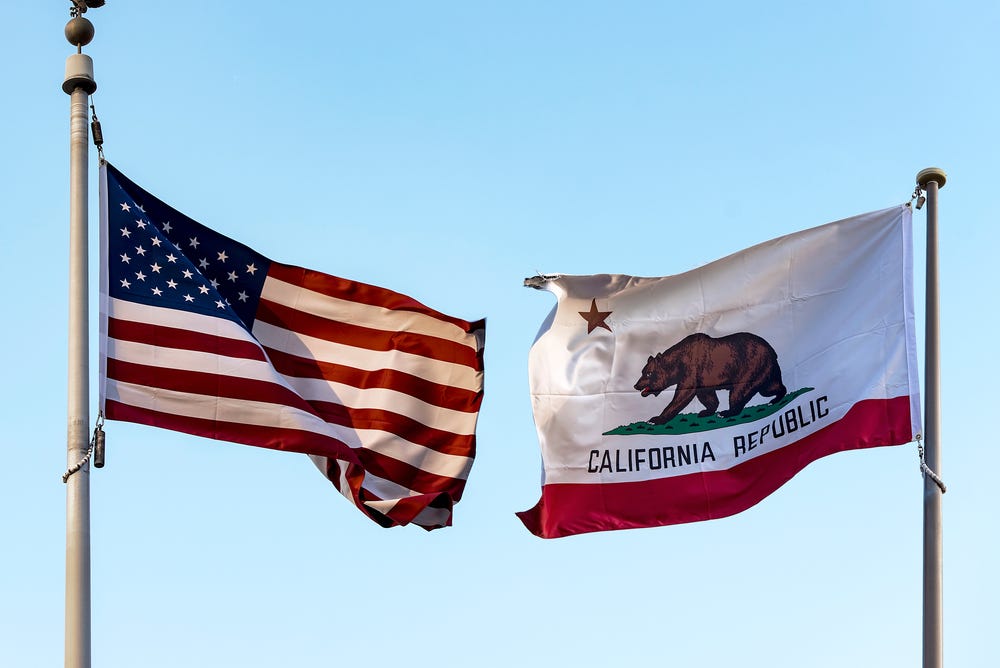
We are a nation of strivers, imaginers, dreamers. Maybe nowhere more than in California, the far edge of the continent and a land of discovery. Gold, oil, rich soil, open trade routes across the Pacific—all were part of a culture of discovery and innovation that continues to this day. It’s a land of continuous striving toward the next discovery, the next frontier. It’s no accident that both the AI race and the space race are rooted in California. As the great Wallace Stegner once noted, the state is “like the rest of America . . . only more so.”
But California is, or should be, also a land of trying and failing, learning from the past, getting up and dusting ourselves off and trying again. Because while we have achieved a huge amount we have not achieved perfection. Huge AI investments are a boon to the state budget, but wealth is increasingly concentrated into the hands of a very small number of people—just nine Bay Area households hold 15 percent of the region’s wealth. Nine households, not nine percent of households. The state is seeing some growth in high wage/high skill jobs and a huge surge in growth in low wage/low skill jobs, with little in the middle to allow for economic mobility. As part of a Climate-Smart Economy initiative co-led by my organization, California Forward, we commissioned a set of focus groups and polling and learned that all across the state, Californians are feeling stuck, living paycheck to paycheck and locked into their current economic conditions with no clear path toward prosperity.
The fact is that economic booms and highs have tradeoffs. They always have. The huge tradeoffs of the industrial revolution? At the beginning, labor rights. Later on, local pollution. Today, climate change. The tradeoff of moving away from fossil fuels and embracing alternative energy sources and non-petroleum based consumer products? That transition has a cost, and can disproportionately harm those places whose jobs and taxes and cultures are based on the legacy economy. The fact that there are tradeoffs is not a reason not to turn our innovative energy and can-do spirit toward the problem, though. It’s a reason to strive, to look again for ways toward that “more perfect” future.
It’s not an easy time to talk about striving. Our political system, combined with the tyrrany of social media (or as Ezra Klein puts it, the “attention economy”), puts huge pressure on our leaders to focus on the wins. It’s become political suicide to admit that a policy challenge is hard, includes tradeoffs, and will take time to solve. The only place where Americans seem to be focused on striving toward something more perfect is when it comes to our bodies—looksmaxxing, longevity obsessions—than about our nation and our culture as a whole.
We’re 250 now. We’re maturing and growing. Even the young upstart Califoria is a ripe 175. Let’s return to a nation of strivers who recognize that we are far from perfect, but also that we the people have the capacity—because of our diversity, our courage, our resilience, our grit—to continue picking ourselves up, admitting and learning from our mistakes, and moving forward. Instead of pining for a mythical America of the past, let’s make America great-er by returning to our roots as strivers and dreamers, unafraid to look our mistakes in the face but also continually working to overcome them.
I personally don’t see another path forward. The world is not what it was when many of our institutions and policies were put in place. Our insurance industry was created when the climate was stable; it wasn’t set up for the kinds of disasters we face today. Much of our infrastructure was designed and built for a fossil fuel-driven economy. Our financial systems reward short term thinking, not long term resilience.
We will need the imagination and energy and courage to rethink some of those instiutions—to not only imagine, but actually fight for, a more perfect union. We can do it—it’s in our genes as a nation, as a state, as a people.
Happy Birthday America! Our story is just beginning.